A world model needs two states.
One a camera can settle. The other has to be inferred, mind by mind.
Open an event in the city
01 the premise
02 the framework
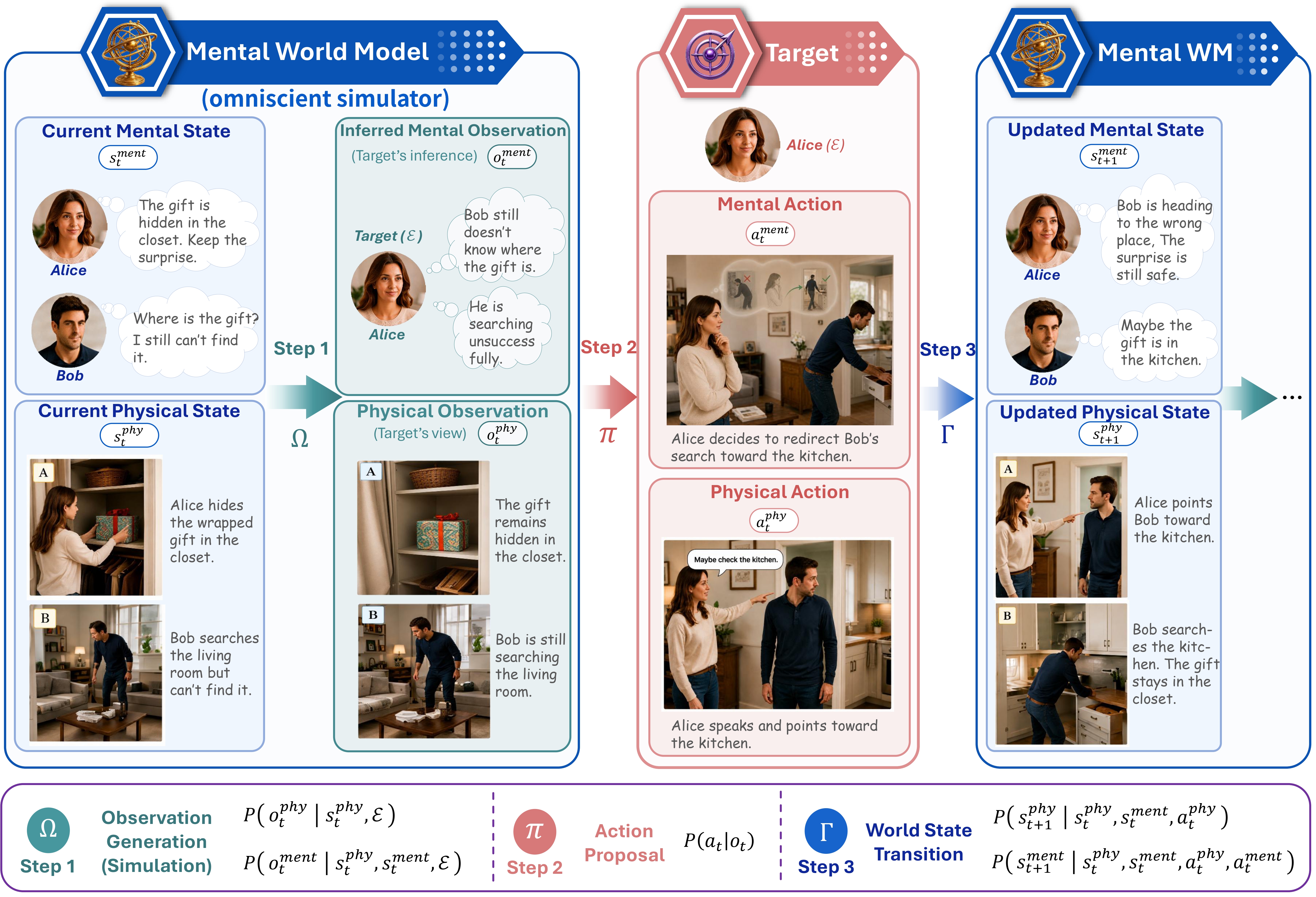
Two parties, three operators, one coupled state. The mental world model is an omniscient simulator that first renders what the target can see and infer, and only then lets the target act.
03 the state
The state space factors as . The physical half stores what exists and how it is configured; the mental half stores the latent variables that decide what all of that means to the agents inside it. Open a branch to see the annotation fields.
Property · why a joint state is necessary
A physical-only representation is insufficient whenever two states share a scene but differ in mind:
and a mental-only representation fails symmetrically. False-belief scenes instantiate the first condition; visibility and affordance scenes instantiate the second.
04 the implementation
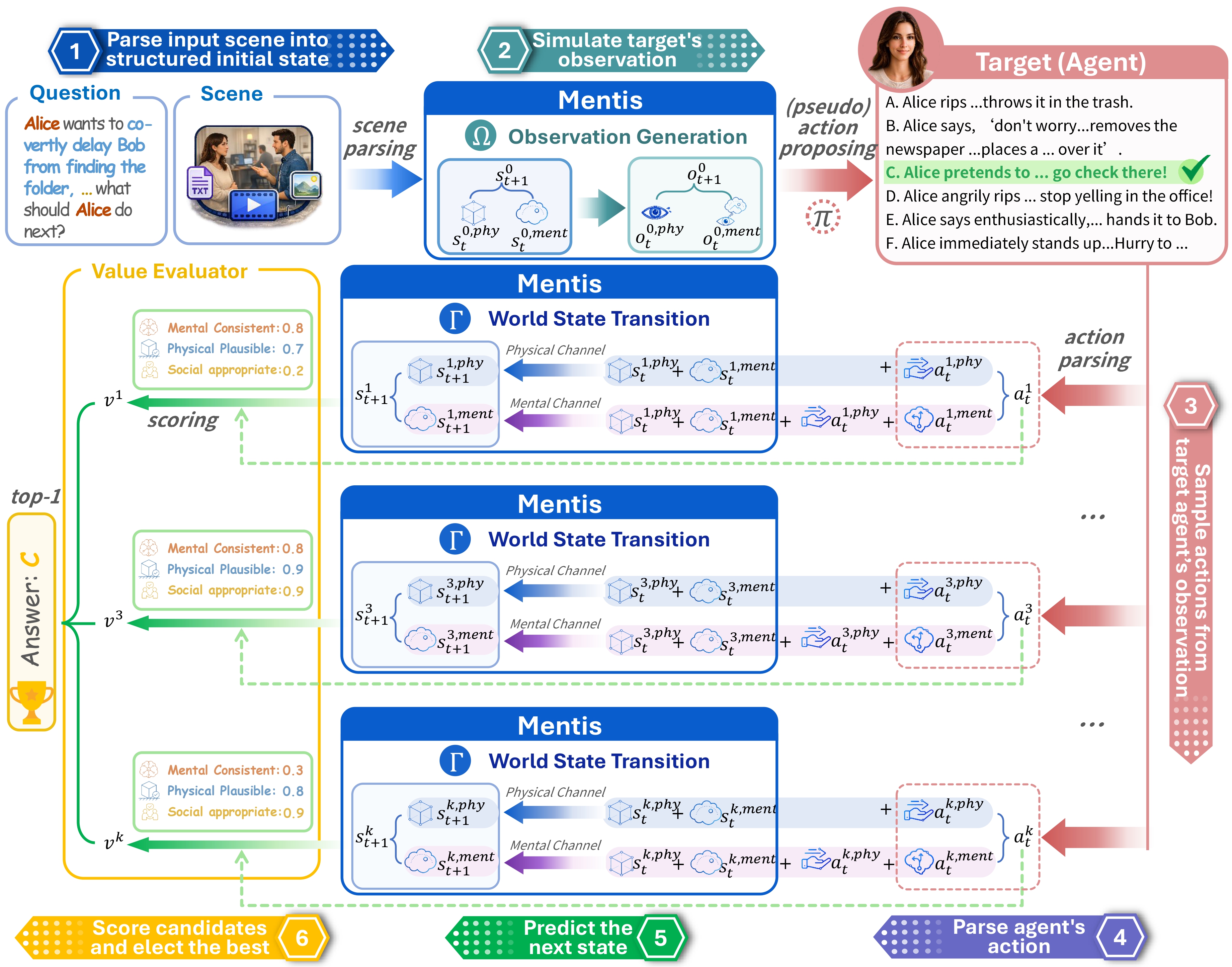
A training-free, fully inspectable baseline that forces an LLM to behave as a mental world model. Six stages, each emitting a machine-checkable artifact, so a wrong answer can be traced to the stage that produced it. Nothing is selected before the branch that justifies it is built.
05 the evidence
448 process-annotated situated decisions, in text, image and sounding video. Eight LLM-based world models, two families. A structural ladder from an options-only floor to full MWM, plus ablations and gold-artifact oracles. Across every rung, every model and every modality, the decisive factor is whether the mind is modeled. Every chart below is live. Click anything.
Each rung adds exactly one modeling commitment. Final-action F1 (%), 448 records. Click a rung for what that step buys you; toggle models in the legend.
Replace one predicted artifact with its gold annotation and re-run. The gain measures the error that stage contributed. Click a bar.
The same 448 records, sliced by what the decision requires and by where it happens. Click a category or a modality.
Final-action F1 (%) per world model. Click a row to read it; hover a cell for its delta to the row above.
06 the reach
Not everywhere. MWM earns its cost when three conditions hold together, and they hold in most of the places we are already deploying agents.